The Performance
Materials for The Azaleas Project were used in the September 17, 2026 Unpoetry at the Frye performance by María Dolores A. Matienzo (percussion and text), Tom Scully (guitar and prepared piano), and Noelle K. Chun (movement). The performance is an ekphrastic response to the Lotus L. Kang exhibition I hear the hollow boom of time at the Frye Art Museum in Seattle, Washington. In consultation with Eric M. Acosta (videographer and editing) of Unpoetry and Anna Buxton and Kathryn Reyes of the Frye, the performers spent time with Kang’s exhibition, work, and artist talks. Through this process, the performers prepared a score.
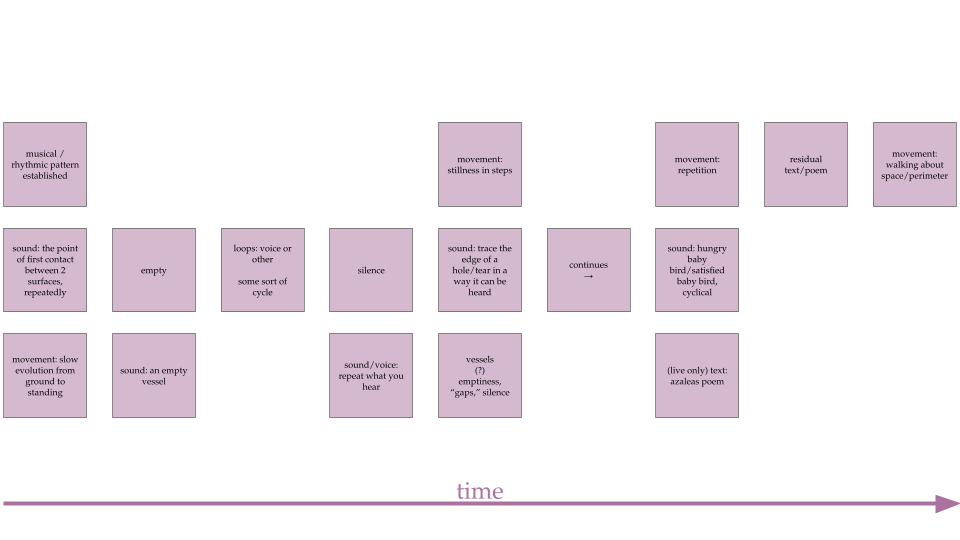
The performer’s score, prepared August 17, 2026.
Kang has written and spoken about the influence of Kim Sowol’s poem on her work, especially her Azaleas series of sculptures. Kang’s timing of the mechanism for the large-scale replica of a 35mm rotary film dryer in the Azaleas series follows the 7·5 syllabic rhythm of Kim Sowol’s “Azaleas” and Kim Hyesoon’s “Already.” The performers thus decided to include the translation of “Azaleas” within the performance and to create the transformations, or new residual poetic texts created from the corpus of gathered translations.
Given capacity constraints, it was not possible to hold the live performance within the exhibition itself. With the assistance of Eric M. Acosta and Tori Winkler (videographers), they filmed a version of their performance inside Kang’s sculpture Azaleas III. For the live performance, the performers responded to the filmed version and performed along themselves while the film was projected in the auditorium.
The title of Kang’s exhibition comes from a line in Clarice Lispector’s novel Água Viva:
Ouço o ribombo oco do tempo. É o mundo surdamente se formando. Se eu ouço é porque existo antes da formação do tempo. ‘Eu sou’ é o mundo. Mundo sem tempo. A minha consciência agora é leve e é ar. O ar não tem lugar nem época. O ar é o não-lugar onde tudo vai existir. O que estou escrevendo é música do ar. A formação do mundo. Pouco a pouco se aproxima o que vai ser. O que vai ser já é.
(I hear the hollow boom of time. It’s the world deafly forming. If I can hear that is because I exist before the formation of time. “I am” is the world. World without time. My consciousness now is light and it is air. Air has neither place nor time. Air is the non-place where everything will exist. What I am writing is the music of the air. The formation of the world. Slowly what will be approaches. What will be already is.)
This combined performance — of what will be that already is — provides what Kang refers to in her own work as “resistance to singularity through repetition.” Through this method, the performers accepted a logistical, curatorial, and safety constraint as one that ultimately informs the collected work of performance more thoroughly. Similarly, the poetic residue in the transformations of the translations of Kim Sowol’s “Azaleas” incorporated into the performance revisits and complicates the interpretations of what is already is: a multiplicity of meanings, translations, rhythm, tonality, and movement.